
When a Transformer Fails, the Supply Chain Is Already Part of the Repair
Restoration time for critical grid equipment is usually decided long before the failure, by which spare was bought, whether it is compatible, and whether anyone can prove it. A guide to treating the supply chain as maintenance work.
Working on a live operating problem? Book Your 20-Minute Assessment
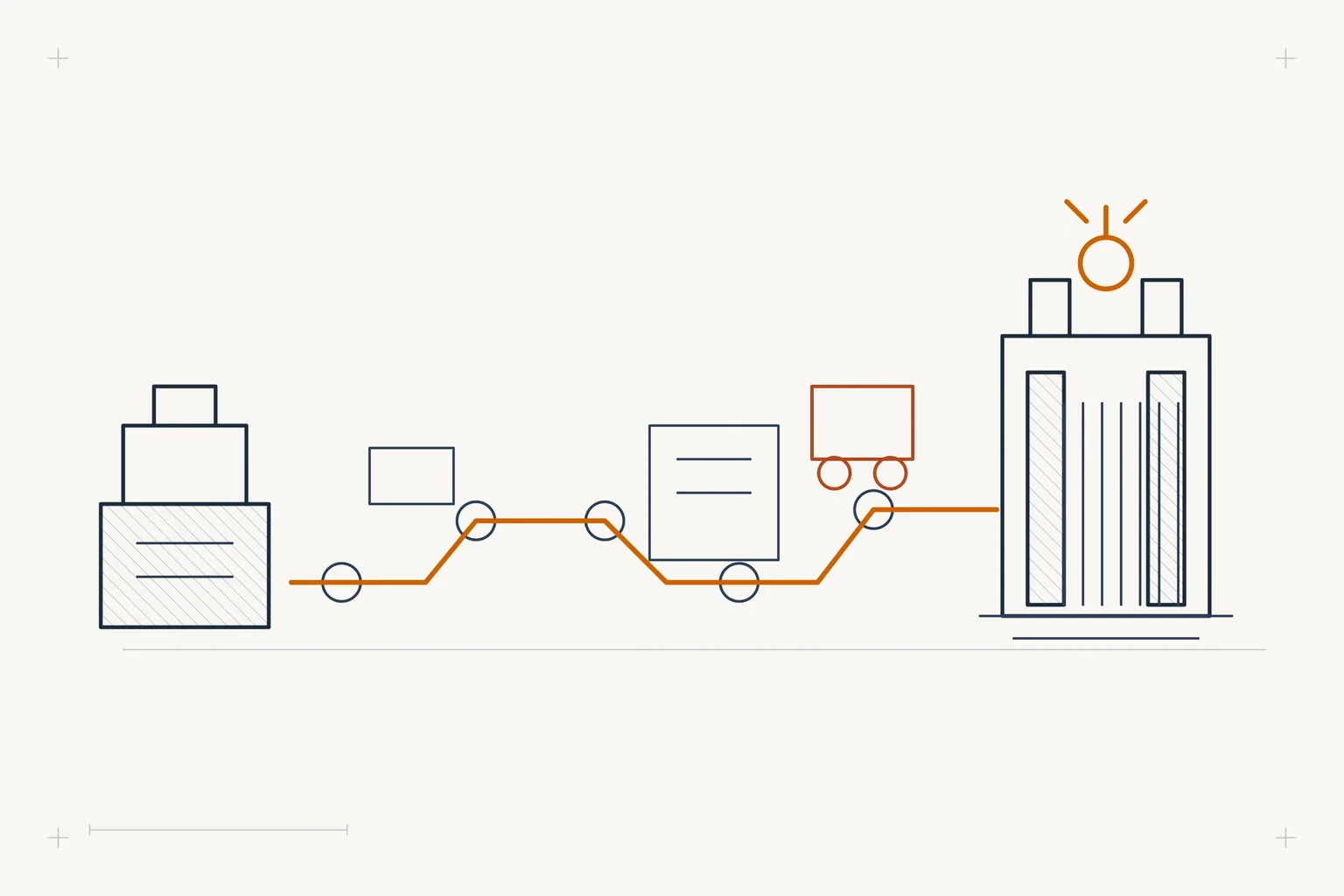
A transformer failure does not begin when the transformer trips.
Whether the utility recovers in days or in quarters was mostly decided earlier: by which spare was purchased and whether it is actually compatible, by whether the drawings and configuration records are current, by whether transport and the pad have been thought about, and by whether anyone knows which supplier can deliver the specific thing that is needed.
For critical grid equipment, the supply chain is not something that happens after the maintenance decision. It is part of the maintenance plan, and it is usually the part that has not been written down.
The numbers that define the problem
Three figures from the Department of Energy set the scale, and each one points at a different failure of preparation.
The Office of Electricity has stated that DOE identified over 80,000 different distribution transformer varieties nationwide, many of them legacy specifications that utilities could modify if they accepted more universal designs and standard accessories. DOE describes the lack of consistent specifications across utilities as a contributing factor to longer production times.
Eighty thousand varieties is not a manufacturing statistic. It is a compatibility statistic. It means that a spare held at one utility is very often not usable at the utility next door, and sometimes not usable at a different substation within the same utility, because a specification decision made decades ago by somebody who has retired constrains what can be installed today.
The second figure is about time, and it has moved since this article was first published. Writing in 2024, the Department of Energy reported that lead times to purchase distribution transformers across the industry and all voltage classes had risen 443 percent, and that orders which previously took two to four months to fulfil were then taking 22 to 33 months.
That peak did not hold. The Congressional Research Service, reporting in April 2026, records that “an industry consultancy estimated that wait times for distribution transformers had decreased to 30 weeks by the second quarter of 2025”. Thirty weeks is still more than seven months for a commodity component, and it is roughly double the pre-2022 position, but it is not two years. Anyone still planning against a 22-to-33-month distribution-transformer horizon is planning against 2024.
Two cautions travel with the corrected number. It is attributed by the Congressional Research Service to an industry consultancy rather than to a federal measurement, and it describes distribution transformers specifically. Large power transformers and generator step-up units are a different market with different lead times, and figures for those must not be used interchangeably with this one.
The third figure is about age, and it has not moved. The Congressional Research Service reports that roughly half of distribution transformers are over 33 years old and nearing the end of their useful life, consistent with the Department of Energy and national-laboratory research putting the figure at about 55 percent. The Congressional Research Service also records that the United States imports 25 to 30 percent of distribution transformers, chiefly from Taiwan, Canada and Mexico, and that between 1.4 million and 2.4 million units are added or replaced each year.
Put those together and the operating position is still uncomfortable, though differently so than it was in 2024. A large installed base past typical design life, an ordering horizon of roughly seven months rather than two years, a quarter or more of supply arriving from abroad, and a specification landscape so fragmented that “we have a spare” is a claim requiring verification rather than a fact.
Large power transformers compound all three. They are frequently custom-engineered to the site, physically difficult to move, and quoted at lead times that have commonly been reported in the three-year range and beyond for extra-high-voltage units.
Working backwards from the failure
The useful way to think about this is not forwards from the trip. It is backwards from it.
Assume a transformer fails today. Every question that now has to be answered under time pressure had an earlier, cheaper moment at which it could have been answered calmly.
What spare exists, and where is it? A register entry is not a spare. A spare is a physical unit at a known location in a known condition with known accessories.
Is it actually compatible? Voltage ratings, impedance, winding configuration, tap arrangement, bushing type and orientation, cooling class, footprint and mounting, protection and monitoring interfaces. Any one of these can turn a spare into a nearly-spare, and nearly is worthless during a restoration.
What engineering records exist, and are they current? Nameplate data, drawings, factory test reports, and the record of any modification since commissioning.
What accessories does it need? Bushings, radiators, conservator or fittings, gaskets, protective relays, and oil. Spares are routinely stored without them, and the missing gasket set is a genuinely common cause of restoration delay.
What does moving it require? Weight, route, permits, crane, transformer trailer availability, and whether the receiving pad and containment are suitable.
What does the condition history say? Dissolved gas analysis trend, oil quality, load history, through-fault counts, thermal history. This determines whether the failure was a surprise or a missed signal, which matters for the next unit of the same vintage.
Who must approve the replacement, and at what threshold?
Which supplier holds which piece of the information? Frequently the OEM holds the definitive compatibility answer, and the utility holds only a purchase record.
The repair begins before the failure
Scroll sideways to see the whole drawing.
Figure 1. The repair begins before the failure. Two parallel paths against the same failure event. The upper prepared path runs left to right through five milestones: commission, where configuration and drawings are captured; operate, where condition and repair history accumulate; plan, where the critical spare and its compatibility are confirmed; fail, the event itself, where evidence and diagnosis are gathered; and restore, where a known path is followed. The lower unprepared path shows what happens instead when the earlier milestones were skipped: search, specify, source, negotiate, transport, and only then restore. Each block on the lower path is hatched and amber, marked as a question the failure asks that nobody has answered yet.
A transformer is more than an asset ID
The reason so many of those questions go unanswered is not negligence. It is that the record of a transformer in most asset systems is a row, and a transformer is not a row.
What has to be known about one transformer before it fails
Scroll sideways to see the whole drawing.
Figure 2. What has to be known about one transformer before it fails. A central hub representing one transformer, noted as being represented in most asset registers by a single row. Around it: nameplate data, drawings and schematics, winding and tap configuration, bushing type and orientation, cooling class and radiators, protection and monitoring interfaces, dissolved gas and oil analysis history, through-fault and load history, the identified compatible spare and its location, required accessories and gaskets, transport route and lifting requirements, the supplier who holds the definitive compatibility answer, warranty position, and the record of previous repairs and modifications. All of it feeds one outcome: whether the restoration path is known before the failure or discovered after it.
Three habits that shorten restoration
Verify spares against installed units, not against the register. A periodic compatibility review that physically checks a sample of held spares against the units they are nominated for will find mismatches. It always does. Finding them on a Tuesday is very different from finding them during a restoration.
Capture configuration at every intervention. Every time a unit is worked on, photograph the nameplate and record what was actually done. This is the cheapest possible defence against the specification drift that makes the 80,000-variety problem personal.
Hold supplier capability, not just supplier contacts. Who can actually build or refurbish the thing you need, at what lead time, and when did you last confirm it. A contact list is not a sourcing capability, and a 22-to-33-month ordering horizon means the confirmation needs a refresh cadence.
The specification question worth asking
DOE’s framing of the 80,000-variety problem contains an uncomfortable implication for asset owners: a meaningful share of that fragmentation is self-inflicted and reversible. DOE notes many varieties are legacy specifications that utilities could modify if they accepted more universal designs and standard accessories.
That is a maintenance decision disguised as an engineering preference. Every non-standard specification a utility retains narrows the pool of units that can be sourced quickly, reduces the usefulness of any spare held by a neighbouring utility or a mutual-aid partner, and lengthens the manufacturing queue for everyone.
The question worth putting to your own engineering standards is not whether the bespoke specification is better. It usually is, marginally. The question is whether the marginal improvement is worth the restoration time it costs when the pool of compatible units is one.
Where AIMMS fits
EQUA AIMMS brings asset history, technical records, part identity, supplier information and repair context into the same fault-to-fix process, so that a team spends less of an outage reconstructing a picture that already existed in pieces. Where a compatibility question depends on a record the utility holds, it assembles the record with its source and its age attached. Where the definitive answer sits with an OEM, it prepares the request rather than inferring an answer.
The boundaries stay explicit. AIMMS holds no write path to protection, control or SCADA systems. Qualified engineers confirm compatibility and authorise installation. Your buyers commit spend under your limits, and your systems of record stay authoritative.
The test
Pick one critical transformer. Give somebody an hour and ask them to produce: the nominated spare, its physical location, its condition, the evidence that it is compatible, the accessories it needs, and the transport requirement.
If that takes longer than an hour on a calm day, it is not going to be faster during an outage. And unlike almost everything else about a transformer failure, this is the part that can be fixed today.
Sources
- U.S. Department of Energy, Office of Electricity, Michael Pesin, “DOE and Industry Team Up to Keep the Lights On for America”, 22 February 2024. Figures cited: over 80,000 different distribution transformer varieties nationwide; distribution transformer lead times up 443 percent; orders that previously took two to four months now taking 22 to 33 months.
- U.S. Department of Energy, Office of Electricity, “Energy Department Researches Distribution Transformer Types and Demand Drivers”, 27 November 2024, reporting NREL research: about 55 percent of in-service distribution transformers are older than 33 years.
- Congressional Research Service, Electricity Distribution Transformers: Supply, Tariffs, and Policy Options, Report R48933, 23 April 2026. Quoted: “an industry consultancy estimated that wait times for distribution transformers had decreased to 30 weeks by the second quarter of 2025.” Also cited: roughly half of distribution transformers are over 33 years old; the United States imports 25% to 30% of distribution transformers chiefly from Taiwan, Canada and Mexico; and between 1.4 million and 2.4 million units are added or replaced each year. Scope: the 30-week figure is attributed by CRS to an industry consultancy, not to a federal measurement, and it describes distribution transformers only.
- U.S. Department of Energy, Large Power Transformer Resilience Report to Congress, July 2024, on large power transformer custom engineering, transport constraints and acquisition lead times.