One Power Fleet, Three Maintenance Models
A gas turbine, a solar inverter and a battery container may support the same megawatt, but they fail differently, are serviced differently, and are warranted differently. What changes when one organisation has to maintain all three.
Working on a live operating problem? Book Your 20-Minute Assessment
A gas turbine, a solar inverter and a battery container may all deliver or support the same megawatt. They fail in almost completely different ways.
They have different manufacturers, different alarm vocabularies, different service intervals, different warranty regimes, different safety requirements, different spare-parts economics, and different technicians. One is a rotating machine with a century of accumulated practice behind it. One is a fleet of power electronics where the same fault happens two hundred times. One is a chemical energy store whose diagnostics live largely in software owned by somebody else.
The United States is adding these to the same portfolios at speed. The Energy Information Administration reported that developers planned a record 86 gigawatts of new utility-scale capacity for 2026, of which solar accounts for about 51 percent (43.4 gigawatts) and battery storage about 28 percent (24.3 gigawatts).
Most of the discussion about that build-out is about building it. This is about the twenty-five years afterwards, when one operations organisation has to keep all of it running.
The real question
It is not how to maintain each asset class. Each has a competent body of practice, and the OEM will supply it.
The question is what a single maintenance organisation should hold in common across three asset classes that have almost nothing physically in common, and what it should deliberately leave different.
Get that wrong in one direction and you build a process so generic that it describes nothing and the technicians ignore it. Get it wrong in the other direction and you run three separate maintenance organisations inside one company, with three sets of parts data, three approval paths, three supplier relationships, and no ability to answer a portfolio-level question about anything.
Three failure characters
Gas generation
Rotating equipment with a mature failure physics. Vibration, lubrication, thermal growth, combustion, seals, bearings, and the auxiliary plant around them: pumps, valves, coolers, and the lube system that quietly causes more outages than the turbine.
The maintenance model is interval and condition based, organised around planned outages, and the outage is the unit of planning. Specialist service is contracted, often from the OEM, often booked far in advance. Parts are expensive, individually tracked, frequently refurbished rather than replaced, and a critical spare is a capital decision.
On gas turbines that contract often carries its own arithmetic, because the inspection interval runs on weighted counters rather than on calendar time. What a trip actually costs the counter follows that through.
The characteristic failure is singular and consequential. One machine, one event, a large exposure, a well-understood diagnostic path, and a plan that mostly exists.
Solar
Power electronics and fleet mechanics distributed across a large area. Inverters, trackers, combiner boxes, string-level faults, medium-voltage transformers, switchgear, and a great deal of cabling exposed to weather and wildlife.
The maintenance model is fleet statistics. The same inverter fault occurs across dozens of units, and the useful question is rarely “why did this one fail” but “which population is failing, at what rate, and is it a batch, a firmware revision, or a site condition”. Truck rolls dominate cost. Individual events are cheap and the aggregate is expensive.
The characteristic failure is repetitive and dispersed. Many small events, a diagnostic answer that only appears at population level, and a parts problem that is about logistics rather than scarcity.
Battery energy storage
Battery racks, power conversion systems, thermal management, controls, fire detection and suppression, and an enclosure that is itself a maintained asset.
The maintenance model is the least settled of the three, and three things make it distinctive. Diagnostics are software-mediated and often the OEM’s software, so the ability to see inside the asset is a contractual question as much as a technical one. Warranty terms are unusually prescriptive about operating envelope and maintenance evidence, so proving what was done matters as much as doing it. And the safety regime around thermal events changes who may approach the asset and when.
The characteristic failure is opaque and constrained. The evidence exists but access to it is negotiated, and the record of maintenance is part of the asset’s commercial value.
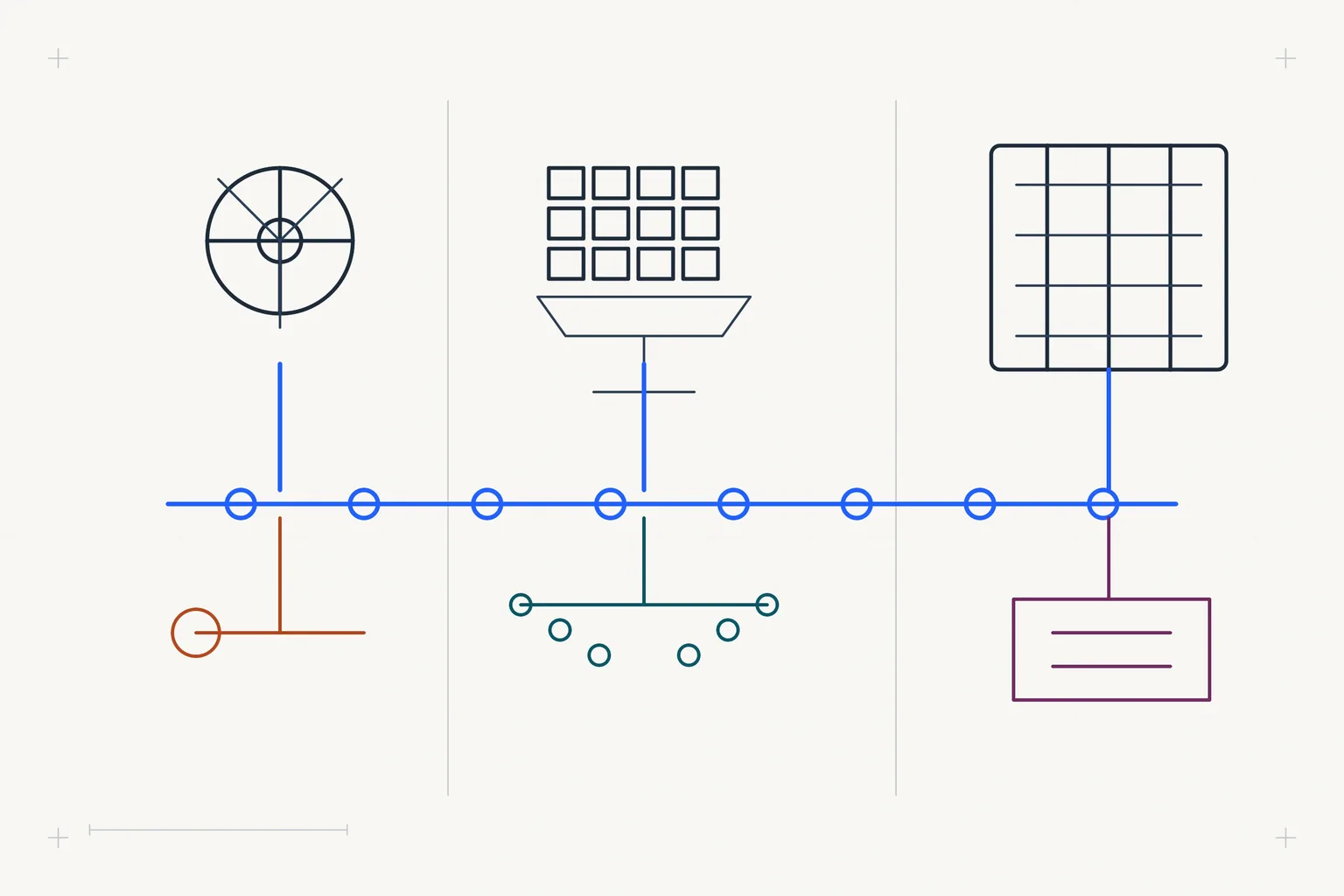
Three asset classes, three failure characters, one maintenance layer
Scroll sideways to see the whole drawing.
Figure 1. Three asset classes, three failure characters, one maintenance layer. Three columns side by side. Gas generation: fails singly and consequentially, with rotating equipment, lubrication and oil analysis, combustion equipment, generator and exciter, balance-of-plant pumps and valves, planned outage windows, and contracted specialist service. Solar: fails repetitively across a population, with string inverters, trackers and drives, combiner boxes, medium-voltage transformers, switchgear, high unit counts across distance, and truck-roll economics. Battery storage: fails opaquely and under constraint, with battery racks and modules, power conversion systems, thermal management, controls and communications, fire detection and suppression, warranty-constrained procedures, and OEM-mediated diagnostics. Beneath all three, a single shared band lists what stays common: fault evidence, repair history, part identity, supplier performance, work coordination, approvals, closeout, and captured knowledge.
What should be common
Eight things, and the test for each is the same: would standardising this help a technician, or only help a report?
Fault evidence. How a fault is captured, what is attached to it, and what a complete evidence set looks like. The content differs entirely by asset class. The discipline should not.
Repair history. Every asset accumulates a narrative. What was suspected, checked, eliminated, done. A turbine’s narrative and an inverter’s narrative are different in every particular and identical in structure.
Part identity. The single highest-value common capability, and the one most often left to each site. Knowing which part fits which asset in its current configuration is the same problem in all three columns, and the same rebuild-drift failure mode destroys it in all three.
Supplier performance. Who quotes, who delivers, who is late, and on what. Almost nobody holds this at portfolio level, which means every site negotiates from anecdote.
Work coordination. Getting the crew, the isolation, the permit and the window to agree. The permits differ. The dependency structure does not.
Approvals. One set of authority rules, thresholds and roles, applied consistently. Three separate approval cultures inside one company is a governance finding waiting to happen.
Closeout. What a complete record looks like, and when it is written. For battery storage this has direct commercial consequences, because warranty defence depends on evidence.
Captured knowledge. What was learned, attached to the asset, retrievable at the next fault.
What should stay different, and why insisting otherwise fails
Diagnostic logic. Turbine vibration analysis and inverter fault-code interpretation have nothing useful to say to each other. Any attempt to abstract them into a common diagnostic framework produces something too vague to act on.
Failure taxonomy. A shared failure-code list across the three classes will be either enormous or meaningless. Let each class use the vocabulary its technicians and OEMs actually use, and map upward only for reporting.
Intervals and planning units. Gas plans around outages, solar plans around routes and seasons, storage plans around warranty and augmentation. Forcing a common planning cadence breaks all three.
Safety procedure. Obviously and non-negotiably specific. Standardise the requirement that a procedure is followed and evidenced, never the content.
Who is qualified. A technician competent on a turbine lube system is not thereby competent inside a battery enclosure. Common competency records, entirely different competencies.
The three failure modes of a mixed fleet
Three patterns show up repeatedly when one organisation takes on all three.
The gas organisation absorbs the others. The largest and most established practice writes the process, and it is built around planned outages and individually tracked capital spares. Applied to a solar fleet it produces a work-order-per-inverter-fault regime that buries the team in transactions and never surfaces the population pattern that is the actual answer.
The OEM contract becomes the maintenance strategy by default. Particularly with storage, where the service agreement, the warranty and the diagnostic access are bundled. The result is an operator who cannot answer basic questions about their own asset without asking the vendor, and who discovers at renewal that the leverage is entirely one-sided.
Parts data forks three ways. Each class arrives with its own catalogue conventions, and nobody reconciles them. Two years later the portfolio cannot answer whether it holds a spare for a given failure, which is the one question a portfolio exists to answer.
Where AIMMS fits
EQUA AIMMS is designed to be the common layer in the drawing above rather than a replacement for any asset-class practice. It assembles fault evidence with each item traced to its source, holds the repair narrative against the asset, reconciles part identity against the installed configuration, prepares the sourcing route, routes approvals under the customer’s own authority rules, and keeps the closeout record complete while the work is happening.
Two boundaries matter especially in this sector. AIMMS holds no write path to plant control systems and issues no setpoints, restarts, interlocks or actuator commands. And where an OEM mediates access to an asset’s diagnostics, AIMMS works with what the customer is contractually permitted to read, and shows what it cannot reach rather than inferring around it.
The practical starting point
Do not begin with a portfolio-wide programme. Begin with the one thing that is common, painful and measurable in all three columns.
That is almost always part identity. Take the last twenty parts-driven delays across the whole fleet and sort them into two piles: the part was absent, or the part was present and wrong. If the second pile is substantial, the problem is not inventory levels and no amount of stock will fix it.
That answer looks the same whether the asset is a turbine, an inverter or a battery rack, which is exactly why it is the right place to build something common.
Sources
- U.S. Energy Information Administration, planned 2026 utility-scale capacity additions, as reported in pv magazine USA, “Solar and storage to lead 86 GW capacity surge in 2026”, April 2026: approximately 86 gigawatts planned, solar about 51 percent (43.4 gigawatts), battery storage about 28 percent (24.3 gigawatts), wind about 14 percent (11.8 gigawatts).