
Secondary sector · Power Delivery & Grid
When the replacement is three years out, the spare you already own decides the event.
AIMMS handles the permitted digital tasks around utility maintenance. It connects asset records, drawings, event evidence, exact components, critical spares, suppliers, approval rules, field coordination, and closeout without entering switching or protection authority.
What you get The drawings, the event record, the approved settings baseline and the installed-configuration match assembled into a package a qualified engineer can review and release the same shift.
- No relay or SCADA writes
- Qualified utility review retained
- Spares matched to as-installed
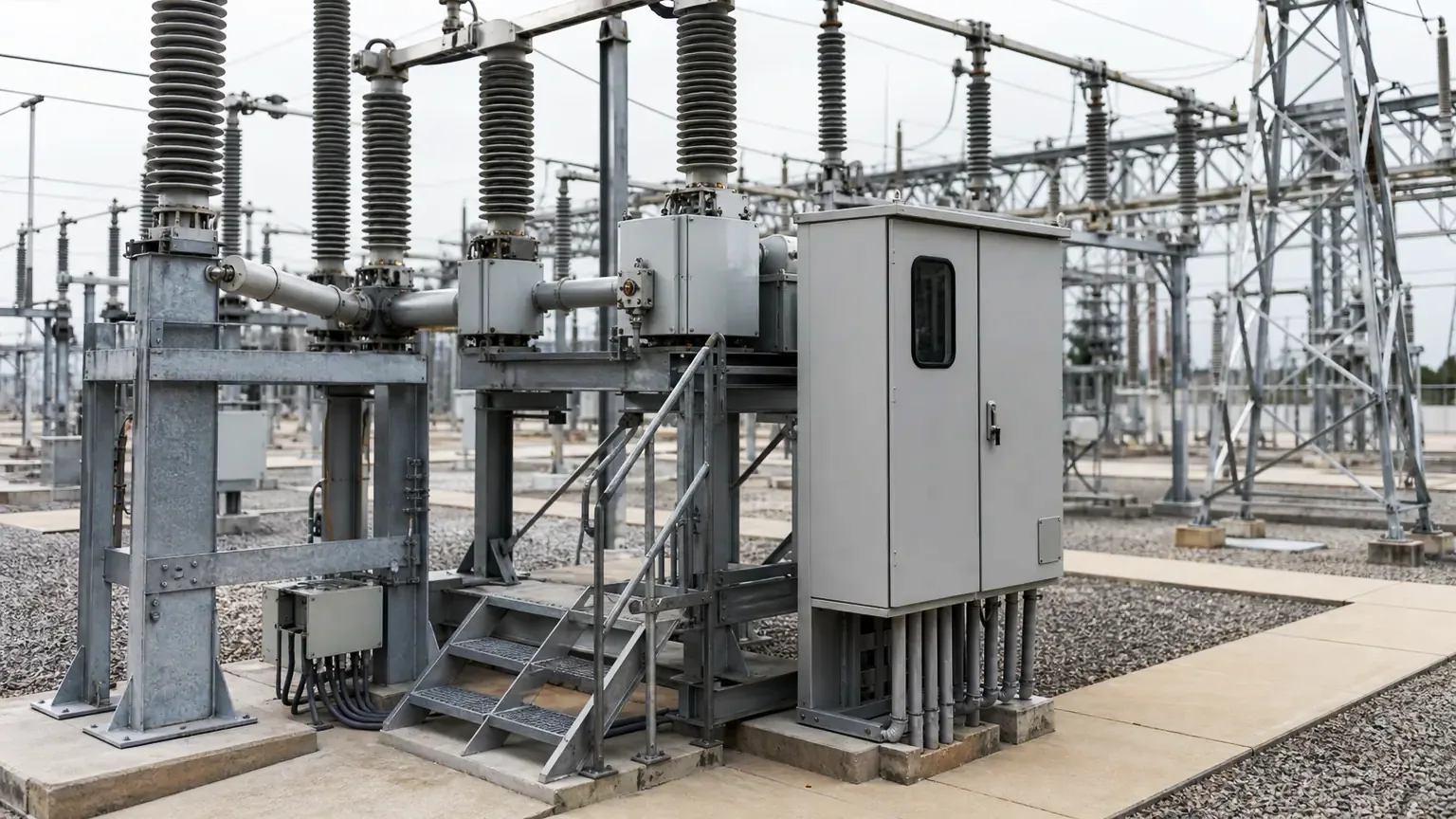
Fault Substation component with a multi-year replacement lead time
AIMMS Evidence, parts, suppliers, approvals
Return Released work and traceable closeout
Read-only grid context · Qualified utility review · Direct grid-control writes permanently out of scope
Why maintenance is getting harder here
Older equipment. More configurations. Longer replacement horizons. More load.
Each one is a published third-party figure on United States grid equipment and infrastructure condition, carrying its source, its year and the population it was drawn from. None is an EQUA result and none describes your network. What each one does to a repair, and what AIMMS does about that, is stated beside it.
-
Critical assets are staying in service longer.
D+ the national grade for United States energy infrastructure, down from C- in 2021 ASCE 2025 Report Card for America’s Infrastructure, opens in a new tabDuring the repairSubstation auxiliary plant, protection cabinets and transformers stay in service well past the point where the drawing set and the installed configuration can be assumed to agree.
What AIMMS changesAssembles the asset record, the prior work and the operating evidence around the finding so the engineering review starts from a complete picture rather than from a search.
-
The right part is harder to get right.
80,000+ distinct distribution transformer varieties identified nationwide, many of them legacy specifications that fragment what a spare at one utility can actually be used for US Department of Energy, Office of Electricity, opens in a new tabDuring the repair"We have a spare" stops being a fact and becomes a claim requiring verification. A specification decision made decades ago by somebody who has retired constrains what can be installed today.
What AIMMS changesReconciles the installed configuration against the parts record and the approved alternates, and confirms usable stock rather than counted stock, before a second unit is ordered.
-
And it is harder to get fast.
128 weeks average power transformer lead time in Q2 2025, with generator step-up units averaging 143 weeks, and high-voltage circuit breakers reaching 151 weeks by late 2023 Wood Mackenzie, Q2 2025 lead times, published October 2025, opens in a new tabDuring the repairThe sourcing route is decided in the first hours after a finding, and a wrong decision is not recoverable inside the same outage season. Every day the request sits unassembled is a day added to a horizon already measured in years.
What AIMMS changesPrepares the requests, tracks each response against the case, and assembles the replies into one comparison a buyer can act on without rebuilding it.
-
There is less room for being wrong.
4x to 6x what a large power transformer costs today against its price before 2022, on the same reporting Wood Mackenzie, reported November 2025, opens in a new tabDuring the repairA wrong variant is no longer a restocking fee. It is a capital-scale error that consumes a replacement slot somebody else in the fleet was waiting for.
What AIMMS changesRoutes the release to the authorized owner with the configuration match, the stock result and the supplier comparison already attached, and preserves a held or denied gate exactly as it was set.
Together these say the replacement market is slow and expensive, which is why reconciling what failed against what you already hold is now the highest-value step in the workflow. They say nothing about how long your own findings wait for that reconciliation. Your release log answers that.
Published third-party sector research does not establish AIMMS effectiveness. Only a baselined deployment on the customer's own workflow can do that.
Your own arithmetic
Price the gap between an accepted finding and released field work.
Two numbers off your own work management system: how many substation corrective events reach the crew in a year, and how long each one waits between an accepted finding and a reviewed, released package. Nothing is projected onto either.
Move both controls. Use your own release log, not our example.
These are your release-log numbers. No released hour is credited to AIMMS anywhere on this page. Nothing you type here leaves your browser.
This section needs JavaScript to do your arithmetic. The figures beside it are the worked example for 45 substation corrective events a year at 16 waiting hours each. To use your own numbers, open the full value model.
720 hours a year
That is crew-ready work waiting on context, not on a clearance.
Crew and bucket standby, contractor mobilization, expedited sourcing, deferred restoration exposure. Enter the number your planners already use, or leave it empty.
Add a loaded hourly figure and this line becomes an annual number a rate case or a budget review can examine.
They arrive there as events a year, avoidable hours per event, and cost per hour, where your finance team can argue with each one separately.
Book Your 20-Minute Assessment What the utility gets
Release field work sooner, with utility authority intact.
Four operating outcomes the AIMMS workflow is built to produce around a substation finding and its spares decision. They are outcomes we design for and draw hatched.
Your KPI contract On a utility pilot, the deciding numbers come off your own release log and your own spares ledger. Six KPIs, agreed and baselined on the selected asset family before any finding is routed through AIMMS, then reported against that baseline. See the KPI contract this pilot will measure.
Build the utility value model on your own reliability economics KPI contract
Measure the time between an accepted finding and released field work.
Baseline the current release workflow before the pilot starts, measure the pilot against that baseline, and expand only when the evidence supports the decision. Every number here is measured on your own substations.
- Time to field-ready work
- Elapsed time from accepted finding to a reviewed and released package.
- Evidence readiness
- Required drawings, event records, baselines, and procedures available at review.
- Part certainty
- Exact component or approved alternate confirmed against installed configuration.
- Supplier cycle
- Elapsed time from sourcing need to comparable and usable response.
- Approval traceability
- Required qualified reviews and releases captured with actor and evidence.
- Record completeness
- Field result, configuration effect, receipts, and closeout captured.
Inspection complete · Field work waiting
A signal is not a work package, and a document set is not operating context.
The complete decision may span EAM, GIS, engineering drawings, event records, approved baselines, spares, ERP, suppliers, emails, and a small number of experienced people. The field team waits while that context is reconstructed.
Where elapsed time accumulates
- 01 Signal or inspection finding
- 02 Asset and engineering context assembled
- 03 Evidence reviewed by qualified personnel
- 04 Exact component and spare verified
- 05 Approval and field release routed
- 06 Work, receipts, and record closed
AIMMS prepares and moves the digital work. Qualified utility personnel review, release, and execute it.
Incoming line
Station breaker
Power transformer
Station bus
Protection and controls
Modelled clock from an accepted finding to an energized asset
16 of 26.5 modelled hours are neither engineering judgment nor field work. They are context being reassembled.
- 1 h Finding accepted by qualified personnel Waiting on coordination
- 4 h Drawings, event record and approved baseline assembled Waiting on coordination
- 3 h Qualified engineering review Hands on the asset
- 4 h Installed configuration and cross-site spare reconciled Waiting on coordination
- 5 h Sourcing, allocation and spend approval Waiting on coordination
- 6 h Field work under clearance Hands on the asset
- 1.5 h Energization and return to service Verified and returned
- 2 h Configuration record and closeout Waiting on coordination
Segment lengths follow the modelled premise stated further down this page. Hatched blocks are modelled waiting, solid blocks are qualified human work including the engineering review, and the green block is the utility’s own energization.
Stated-premise model
What the release gap is worth across one substation programme in a year.
A utility running 45 substation corrective events a year across auxiliary systems and the critical-spares programme, each holding 16 hours between an accepted finding and released field work.
- 45 corrective events a year
- One asset family or one spares programme. Not the full corrective backlog across the network.
- 16 h waiting per event
- From an accepted finding to a reviewed, released package with the configuration matched, the spare allocated and the spend approved. Excludes the engineering review itself, the field work and energization.
- 0 h improvement assumed
- No AIMMS effect is present in this arithmetic. It sizes the release gap and stops.
720 modelled release-gap hours a year
Roughly 30 elapsed days a year of crew-ready work waiting on context rather than on a clearance.
45 events multiplied by 16 waiting hours is 720 hours. Every input is an assumption we chose and printed, which is why the figure is hatched. Substitute your own in the calculator at the top of this page.
Modelled from the stated premise and the assumptions shown. No AIMMS effect is applied.
Start outside protection authority
Begin with high-value grid work that has a defensible authority boundary.
Critical-spares assurance, auxiliary-system return, commissioning handoff, and evidence preparation create material value without beginning inside protection control.
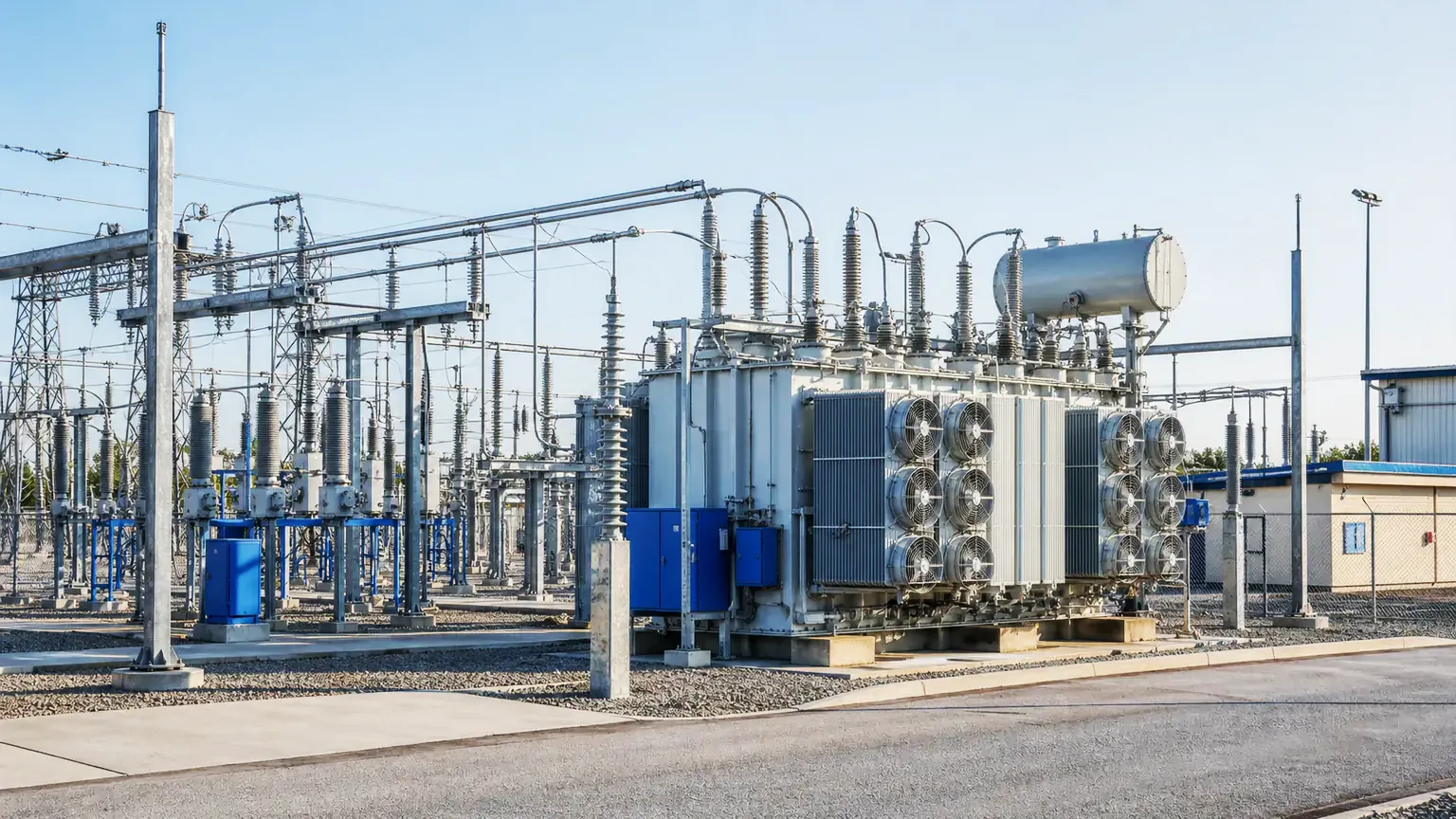
Substation primary equipment
Transformers, breakers, and specialized components where configuration, engineering evidence, exact parts, and spares must align.
Substation auxiliary systems
Station batteries, chargers, cooling, enclosure HVAC, communications support, compressors, and fire-detection support.
Critical spares and suppliers
Installed configuration, manufacturer part and revision, approved alternates, cross-site stock, warranty, RFQs, quotes, and allocation.
Commissioning to operations
As-built drawings, test evidence, approved settings baselines, deficiencies, operating procedures, warranties, and vendor context.
The same everywhere
What does not change when the asset does.
The parts above are specific to power delivery & grid. These are not: they are the same system, the same boundary and the same business case whichever operation you run.
- The operating contract The same seven questions answered at all six stages: what starts it, what AIMMS reads, what it does, who decides, what happens when something is missing, what is left behind, and what a pilot measures.
- One fault, followed end to end A single pump fault from the anomaly AIMMS detects in read-only telemetry, or the alarm that reaches it first, through to verified return with the record already complete.
- Security, control and authority Who can do what, what is read-only, what AIMMS does when a dependency fails, and why no setting exists that would let it write to a control system.
- The business case, on your numbers Five visible formulas, every input supplied by your finance team, and our measured production evidence kept on the other side of an explicit boundary.
Further reading
Written about power delivery and grid.
Each of these answers one operating question in full, with its sources named in the text. They are the working detail behind the argument on this page.
- Article When a Transformer Fails, the Supply Chain Is Already Part of the Repair Restoration time for critical grid equipment is usually decided long before the failure, by which spare was bought, whether it is compatible, and whether anyone can prove it. A guide to treating the supply chain as maintenance work.
- Guide One Pump, Four Identifiers: Mapping the Alarm Tag to the Asset ID A pump has a SCADA tag, a CMMS asset record, a GIS feature and a spares line, and nothing makes them agree. How to build the mapping, what the worksheet looks like, and what to do with the identifiers that will never reconcile.
- Guide Grading the Autonomy Claim: The Questions to Ask a Vendor Whose AI Acts Without You A buyer-side interrogation instrument for maintenance AI. The questions, the evidence a good answer produces, and the red flag a bad answer leaves. Plus what the market actually publishes, and EQUA's answers to its own questionnaire.
- Guide The Maintenance Benchmark Provenance Ledger: Published, Practitioner Opinion, or Folklore Figure by figure: where each maintenance benchmark actually comes from, what was measured, the sample and the year, and whether it traces to a primary source at all. EQUA's own four numbers are graded by the same rule.
Power Delivery & Grid FAQ
Direct answers for substation engineering, field operations, supply chain, and cyber.
The first conversation should resolve where the workflow starts, how far it stays from protection authority, and how release time will be baselined.
Does AIMMS replace our EAM, GIS, ERP, SCADA, engineering, or event-record systems?
No mandatory replacement is required. Those systems remain authoritative. AIMMS creates a controlled Data Twin for the selected workflow and connects the permitted context needed to prepare, review, release, and document the work. Pilot writeback stays inside AIMMS. External CMMS, EAM, or ERP writeback requires customer approval and a validated integration.
Can AIMMS change relay settings, protection logic, or switching state?
No. Relay, protection, settings, trip-logic, SCADA, switching, actuator, and energization writes are permanently outside AIMMS scope. Qualified utility personnel retain engineering review, field release, switching, protection, and return authority.
Where can a grid deployment create value first?
Strong starting points are transformer or breaker critical-spares assurance, substation auxiliary-system return to service, commissioning-to-operations handoff, or event-evidence preparation for qualified engineering review.
How does AIMMS improve critical-spares decisions?
It connects installed configuration, manufacturer part and revision, approved alternatives, warranty, usable local or cross-site stock, supplier lead time, quotes, allocation, approval, and the final field record.
What is the target timeline for a first utility pilot?
The working target is two weeks to configure the Data Twin and workflow, followed by a focused 30-day pilot across 10 to 20 selected assets. Scope and timing adjust to evidence readiness, cybersecurity review, qualified resources, and integration complexity.
Where do the lead-time and infrastructure figures on this page come from?
The benchmark band cites Wood Mackenzie, the Duke University Nicholas Institute analysis, and ASCE inline. The stated-premise model prints every assumption beside the hatched figure. The measured deployment scope and limitations sit directly below the four EQUA metrics.
Bring us the grid-support workflow that keeps waiting on context, components, or review.
In 20 minutes, we will map the signal-to-released-work path, the digital tasks AIMMS can move, the utility authority boundary, and a measurable first-deployment target.
One operating problem. One focused working session. No obligation.