
Why Pump-Station Repairs Take Longer Than the Repair Itself
Replacing a failed bearing may take an hour. Getting to the point where a technician can replace it routinely takes days. One realistic failure at a remote station, step by step, and the question of which steps needed a wrench.
Working on a live operating problem? Book Your 20-Minute Assessment
Replacing a failed bearing assembly on a pump may take an hour. Getting to the point where the technician can replace it often takes days.
First the fault has to be understood. Then the exact part has to be identified, which is not the same as identifying the part in the catalogue. Somebody checks the storeroom. The inventory system says one is available, but nobody is certain it is physically on the shelf, and nobody is certain the listed revision still fits after the last rebuild. If it is not there, purchasing starts contacting suppliers. A quote arrives. Someone has to approve it. The part ships. The crew, the isolation, and a process window that operations will accept all have to agree on the same two hours.
The wrench time is frequently the shortest part of the repair.
This article follows one realistic failure through that sequence. The station and the asset are composites, not a customer, and no timings here are measured. The point is not how long each step took. The point is which steps involved touching the pump.
Remote Pump Station 14
A wastewater lift station, twenty-eight minutes from the treatment works by road, two duty pumps and no third. Pump P-204 is a submersible with a history that nobody at the utility can recall in detail.
The trip. P-204 trips on overload at 21:40. Motor current had been climbing for roughly forty minutes beforehand, which the historian recorded and nobody was watching, because nobody watches a lift station’s motor current on a Tuesday evening. The standby pump picks up the load and holds it. Wet well level is stable. Nothing is overflowing.
This is the good version of this failure. Redundancy worked.
The assessment. The on-call technician is notified at 21:52. The first decision is whether this is a call-out tonight or a job for the morning. That decision requires knowing how much margin the remaining pump has, which requires knowing the forecast, the current flow, and whether the standby has its own history of trouble. Two of those three take phone calls.
Rain is forecast for Thursday. The decision is morning, with the risk accepted and, importantly, not written down anywhere.
The investigation. The technician arrives at 07:20. Pulling the pump requires the lifting equipment, which is on the other truck. It arrives at 09:10. The pump comes up at 09:50. The lower bearing has failed and taken the mechanical seal with it. Total time with hands on the equipment so far: roughly ninety minutes, including the lift.
Identifying the part. This is where the day changes character. The nameplate is legible. The bearing is a standard size, but the seal is not, and the seal and bearing are supplied as an assembly by the pump manufacturer. The asset record lists a part number. The pump was rebuilt in 2021 by a contractor, and the technician who was there has left. Nobody can confirm whether the listed assembly matches what just came out.
The failed component is sitting on a tarpaulin at a lift station. The record describing it is a catalogue entry written before the rebuild.
The stock check. The inventory system shows one assembly at the main store. The storekeeper checks: the bin holds a similar assembly for a different frame size, mislabelled during a reorganisation two years ago. The count was accurate. The identity was not.
Sourcing. Purchasing contacts three suppliers at 11:30. One replies at 14:00 with a price and no lead time. One replies to a person who left the utility in March. The third replies the following morning.
Configuration confirmation. The supplier who replied needs a serial number to confirm which assembly fits. The serial is on the nameplate, at the station, twenty-eight minutes away. A photograph exists on the technician’s phone, which nobody knows about, because it was taken to document the failure rather than to answer this question.
The quote and the approval. The quote arrives Wednesday morning and exceeds the threshold that a supervisor can release alone. The approver is not refusing. The approver is in a budget meeting and missing one attachment that would let them say yes.
The part, the window, the repair. The assembly arrives Thursday afternoon. Thursday is the rain. The station is now running one pump into a wet-weather event, which is the situation the Tuesday decision was quietly betting against. The repair happens Friday morning and takes about two hours including reassembly and the run test.
The record. The work order is closed the following Tuesday, from memory, with the entry “replaced bearing and seal assembly”.
Which of those steps required a wrench
Four. The lift, the teardown, the fit, and the run test.
Everything else was identification, verification, communication, waiting, and authorisation. And the single most consequential moment in the whole sequence was not mechanical at all: it was the mislabelled bin, which converted a same-day repair into a four-day one and put the station into a rain event on one pump.
Where the interval between fault and fix actually goes
Scroll sideways to see the whole drawing.
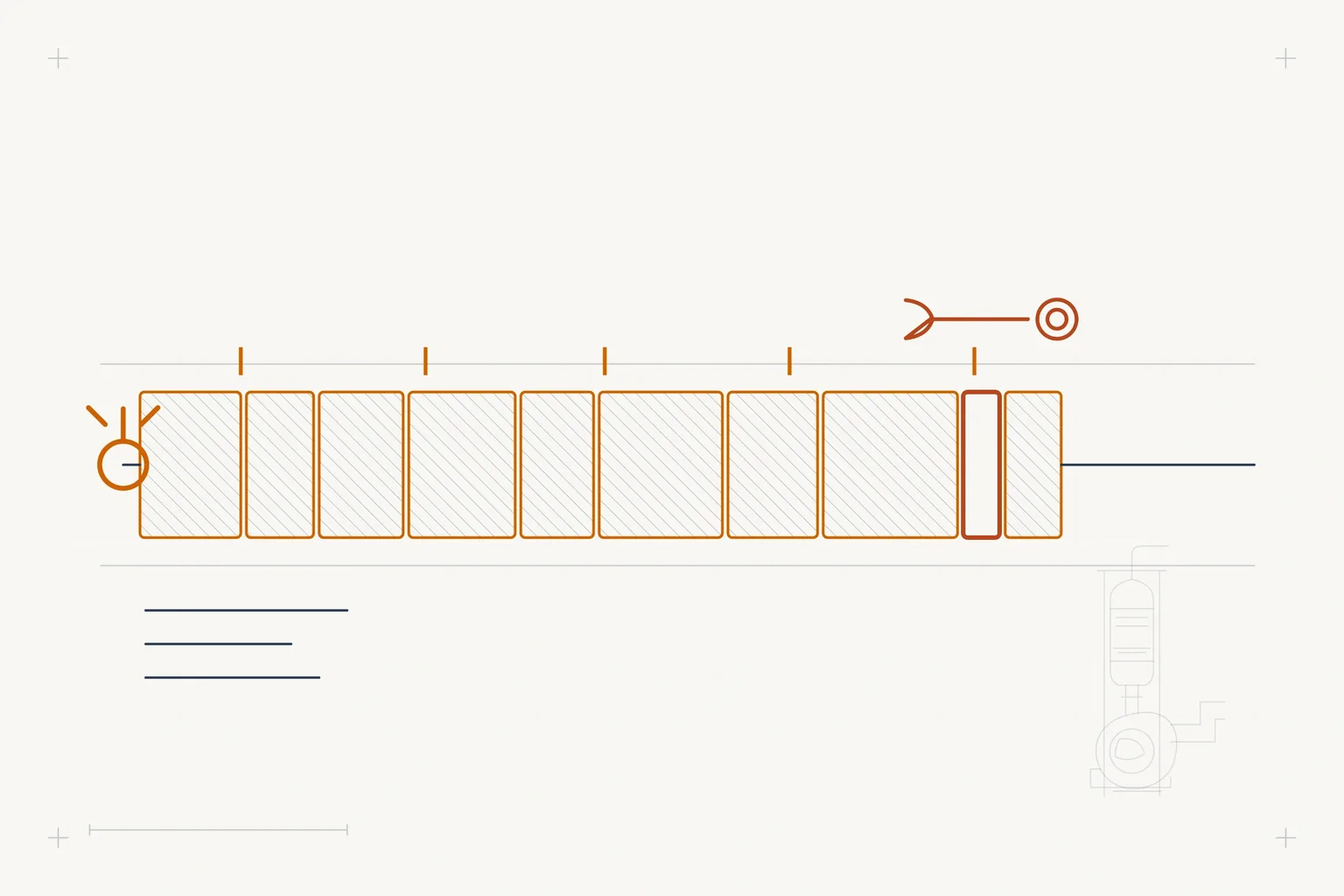
Figure 1. Where the interval between fault and fix actually goes. A single horizontal bar spanning from fault to back in service, divided into nine proportional segments. In order: assess and decide, travel and access, diagnose, identify the exact part, verify physical stock, source and quote, approve, wait for delivery, and then a narrow solid segment for the physical repair, followed by closeout. Only the physical repair segment is drawn solid; every other segment is hatched. A key notes that the solid segment is hands on the equipment and the hatched segments are everything else, and that the bar is proportional with no units, no total and no measured duration.
The two questions that decide everything
Strip the story down and almost all of the avoidable delay traces back to two questions that look like one question.
Which part fits this asset, in the configuration it is actually in? This is a question about the physical machine, and the authoritative answer is on the machine, not in a record. Every rebuild, substitution and field modification widens the gap between what the catalogue says and what is installed, and the gap is invisible until a part is offered up and does not seat.
Is a usable one physically present? This is a question about a shelf. An inventory system answers a related but different question: what the organisation believes it holds. The two diverge through mislabelling, through parts issued and not booked out, through damage in storage, and through shelf life.
Treating these as one question is the single most common and most expensive habit in maintenance stores.
The part decision, and the two branches it commits you to
Scroll sideways to see the whole drawing.
Figure 2. The part decision, and the two branches it commits you to. A decision structure. The trigger is a fault diagnosed and a part required. The question is whether a usable, correct part is physically present. The yes branch is fast: confirm the part against the installed configuration, verify physically on the shelf, reserve it, schedule the crew, isolation and process window, and repair. The no branch is slow: confirm the exact configuration from the asset, identify approved alternates, request quotes from suppliers, chase responses, compare and select, route for approval at the correct threshold, raise the order, wait for delivery, then schedule and repair. The slow branch is drawn with a hatched rail.
What this costs that nobody counts
Three costs in the story never appear in any system.
The decision that was never recorded. Deferring to morning was a reasonable judgement made with incomplete information. Because it was not recorded, nobody can review it, nobody learns from it, and if the station had overflowed on Thursday the reconstruction would have started from memory.
The photograph nobody knew about. The serial number that held up sourcing for a day was already captured, on a phone, forty minutes after the pump came out. The information existed. The retrieval did not.
The second-pump risk that was silently accepted. From Tuesday to Friday the station had no redundancy, through a forecast rain event. That is a real risk position, held for three days, that appears in no register.
Each of these is an artefact of the record being written after the fact rather than during the work.
What actually shortens this
Not a faster technician. The mechanical work was competent throughout and took a few hours.
Confirm configuration at the last repair, not at the next one. A photograph of the nameplate and the fitted assembly, attached to the asset, at the moment of the 2021 rebuild, removes an entire day from this story.
Separate the two part questions in your process. Stock accuracy programmes verify counts. The failure here was identity, which count verification does not detect.
Start sourcing before the diagnosis is final. By 10:00 the probable failure mode was known well enough to begin identifying the part. Waiting for certainty before starting the slow branch is a habit, not a requirement.
Route the approval complete. The approval was not a disagreement. It was a missing attachment. An approval that arrives with the evidence already attached is a different transaction from one that arrives as a request.
Capture the blocker as it happens. Four hours waiting on a supplier is a fact about your supply base. Recorded once it is an anecdote. Recorded every time for a year it is a procurement strategy.
Where AIMMS fits
EQUA AIMMS works on the interval this article describes rather than on the mechanical work inside it. It assembles the evidence around a fault with each item traced to its source, reconciles the part record against the installed configuration, checks usable stock, prepares the sourcing route, and routes the approval to the authorised owner with the evidence already attached. When something is waiting, it says what is waiting and on whom.
The boundaries are the point as much as the capability. Qualified people confirm physical suitability before anything is fitted. Your buyers commit spend, under your limits. Operations control isolation, access and the work window. A denied approval stays denied.
The number worth having
Most maintenance organisations can state their mean time to repair. Very few can decompose it. Deciding what the clock runs between is the part that has to happen before the decomposition is worth anything.
Take your last ten unplanned failures and mark, on each, the moment the technician had everything needed to begin work. The interval before that moment is the part of your downtime that no additional technical skill will reduce.
It is also, in most plants, the majority of it.