EQUA AI Ranks #1 in Inventory AI on F6S, with Top Rankings in Autonomous Agents and Maintenance Management
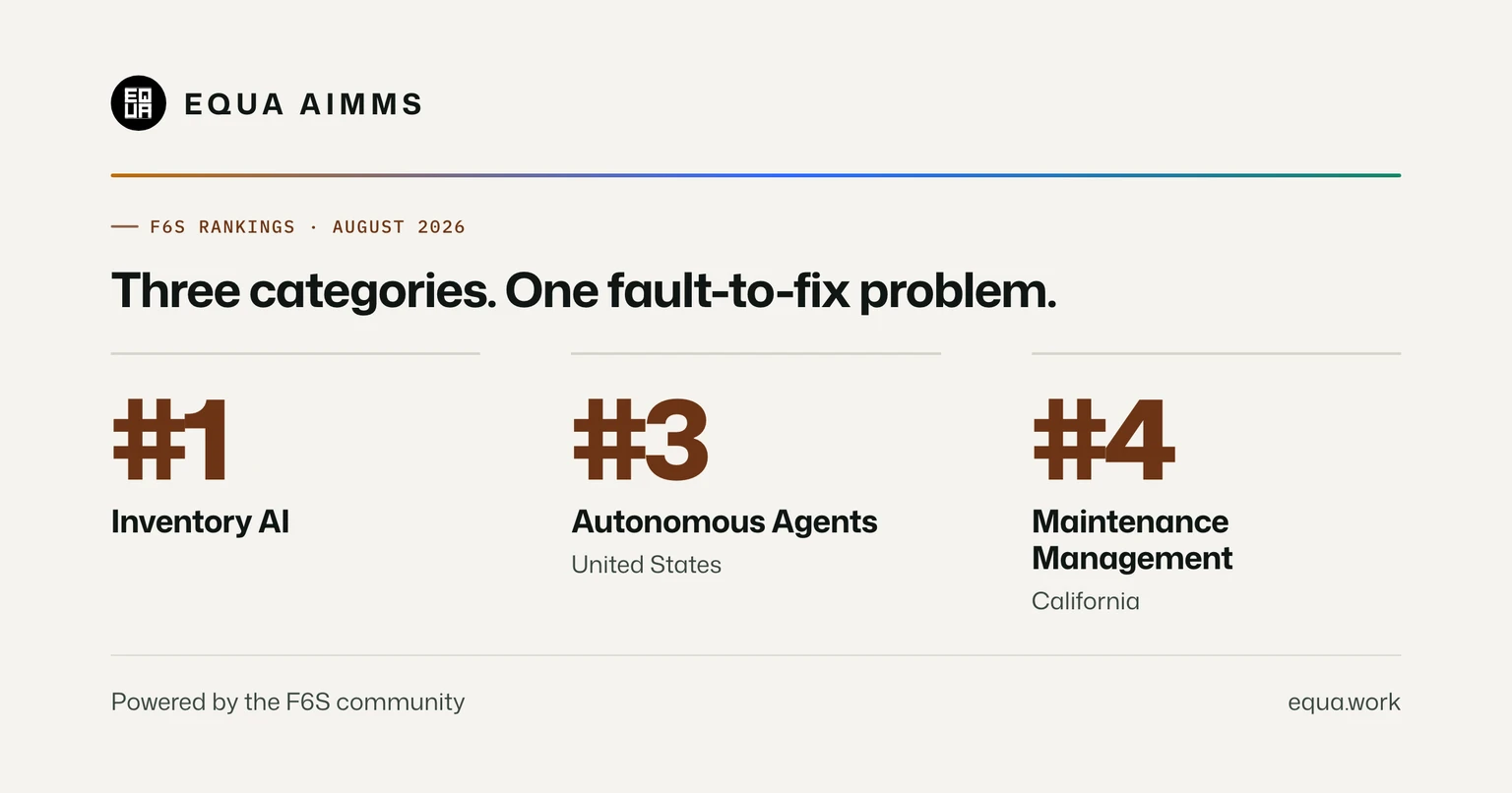
Three F6S community rankings published on 5 August 2026 place EQUA AI first in Inventory AI, third among Autonomous Agents companies in the United States, and fourth in Maintenance Management in California. The three categories describe one problem: the digital work around a repair.
Working on a live operating problem? See AIMMS Do the Work
Recognition: 5 August 2026
EQUA AI has been recognised in three F6S company rankings published on 5 August 2026:
- #1 in Inventory AI
- #3 in Autonomous Agents, United States
- #4 in Maintenance Management, California
F6S describes these rankings as powered by its community, and says its broader platform includes 6.4 million members worldwide.
The most useful part is not any single position. It is what the three of them describe when you put them next to each other.
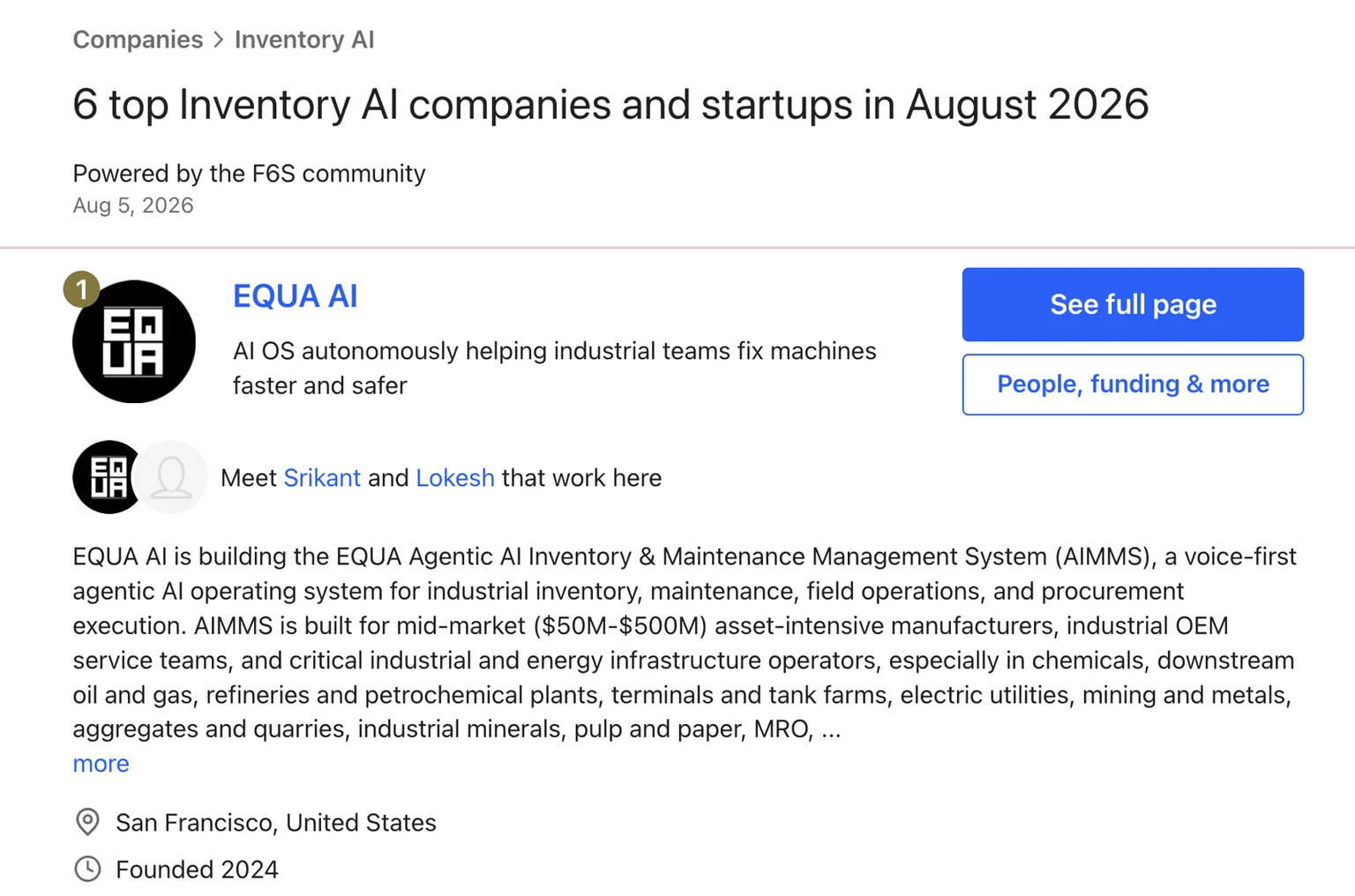
Source: F6S, 6 top Inventory AI companies and startups in August 2026.
Three categories. One fault-to-fix problem.
When critical equipment fails, the work that follows does not happen inside one piece of software.
A fault becomes a diagnosis problem, then a maintenance problem, then a parts problem, an inventory problem, a supplier problem, a purchasing problem, and finally a knowledge problem. Each one is handled somewhere different, and the asset waits through all of them.
The technician still performs the physical repair. But before and around that repair, somebody has to find the right information, work out what failed, identify the correct repair path, verify the part, check stock, source what is missing, keep the work moving, and capture what happened.
AIMMS is built to carry that digital work as one continuous sequence from fault to fix. That is why recognition across inventory, autonomous action and maintenance management is the relevant combination rather than three separate compliments.
#1 in Inventory AI: the right part decides how long the asset stays down
Inventory becomes a maintenance problem the moment a critical asset fails.
It is not enough for a system to report that a part exists. The team needs to know whether it is the correct part for what is actually installed, whether it is on hand, whether it is usable, where it is, and how quickly the missing ones can arrive.
AIMMS connects that decision to the repair rather than to a separate procurement queue. It identifies the required part, checks and reserves usable stock, sources what is missing, and moves the purchasing workflow forward under the customer’s approval rules, without the technician moving between disconnected systems.
The point is narrow and practical. Get the right part to the repair sooner, keep the repair moving, and return the asset to service faster.
#3 in United States Autonomous Agents: doing the work, not returning the answer
AIMMS is designed to go past answering maintenance questions.
Technicians work with it by voice or text and bring photos and video straight into the repair. When a fault arrives, AIMMS can open and build the work order without being asked, assemble the relevant evidence with its source attached, support the search for root cause, and guide the technician using the facility’s own manuals, asset history and operating knowledge.
Then it keeps going. It handles parts and inventory, sources what is missing, moves purchasing, and carries the record through closeout.
That distinction is the whole product. Maintenance teams do not need another place to search. They need the work around the repair to move while the repair happens.
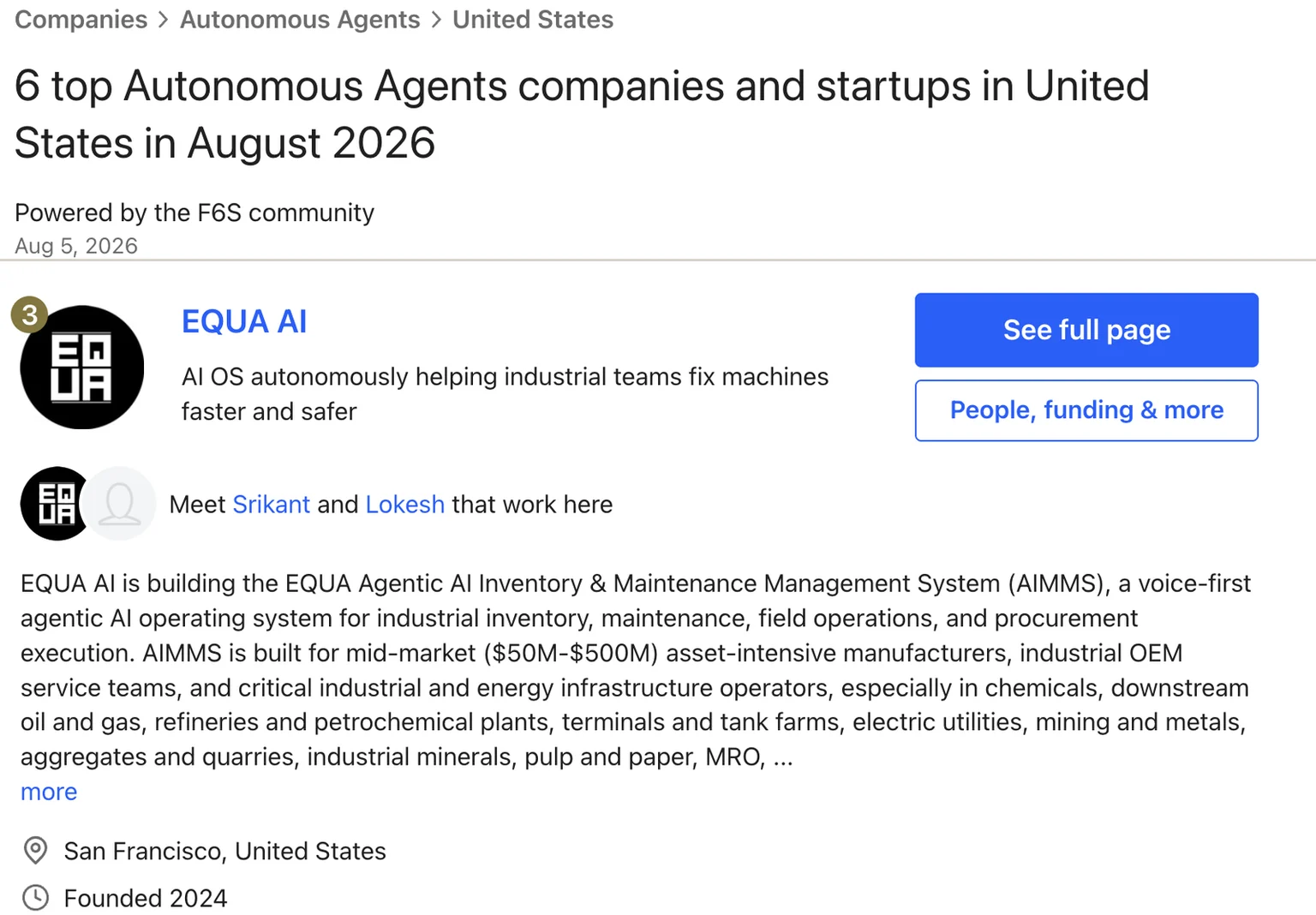
Source: F6S, 6 top Autonomous Agents companies and startups in United States in August 2026.
#4 in California Maintenance Management: the measure is uptime
Autonomous action and inventory intelligence only count if the maintenance outcome improves.
AIMMS is built to help critical infrastructure teams return equipment to service faster, give technicians more productive capacity, lose less time to searching and chasing, improve part readiness, and hold on to what their most experienced people know.
That last one compounds. After a repair, AIMMS captures what failed, what fixed it, which part worked and what the technician learned, and keeps it attached to the asset. The repair ends. The knowledge stays, and the next fault on that asset starts from it.
Source: F6S, top Maintenance Management companies and startups in California.
Recognition is encouraging. Results matter more.
We appreciate the rankings, but recognition is not the outcome AIMMS is built for. The real measure is what happens when critical equipment fails.
31.7%
lower mean time to repair
14.2 h9.7 h
Measured in one anonymized industrial production deployment, on the deployed repair workflow. An average of 4.5 fewer hours per repair event in that deployment.
For an infrastructure operator, that is the goal stated plainly: less searching, less chasing, less waiting, more technician capacity, and more critical equipment running.
These rankings are meaningful because they sit at the intersection AIMMS was built for. A failed asset does not create separate maintenance, inventory and AI problems. It creates one urgent fault-to-fix problem. AIMMS brings that work together, from understanding the failure and guiding the technician through to parts, inventory, sourcing and closeout. What matters is getting critical equipment back into service faster, and making sure the knowledge from every repair stays with the facility.
Srikant Naidu, Founder, EQUA AI
Building the autonomous maintenance system for critical infrastructure
We are continuing to build AIMMS around one idea. When critical equipment fails, your crew keeps the wrench and AIMMS does the digital work around the repair.
It gives technicians an always-available technical teammate, turns scattered facility knowledge into something that can be acted on, moves the workflows that otherwise create the delay, and builds institutional memory out of every completed repair.
Our thanks to the F6S community for the recognition. Now we keep building.
You can also view EQUA AI on F6S.