What EQUA AIMMS Connects To, and What Stays the System of Record
A water utility already owns a CMMS, a historian, a GIS and an ERP, and is not replacing any of them. This sets out what AIMMS reads from each, what it writes back only where a customer configures it, what stays authoritative, and what to ask any vendor claiming an integration.
Working on a live operating problem? Book Your 20-Minute Assessment
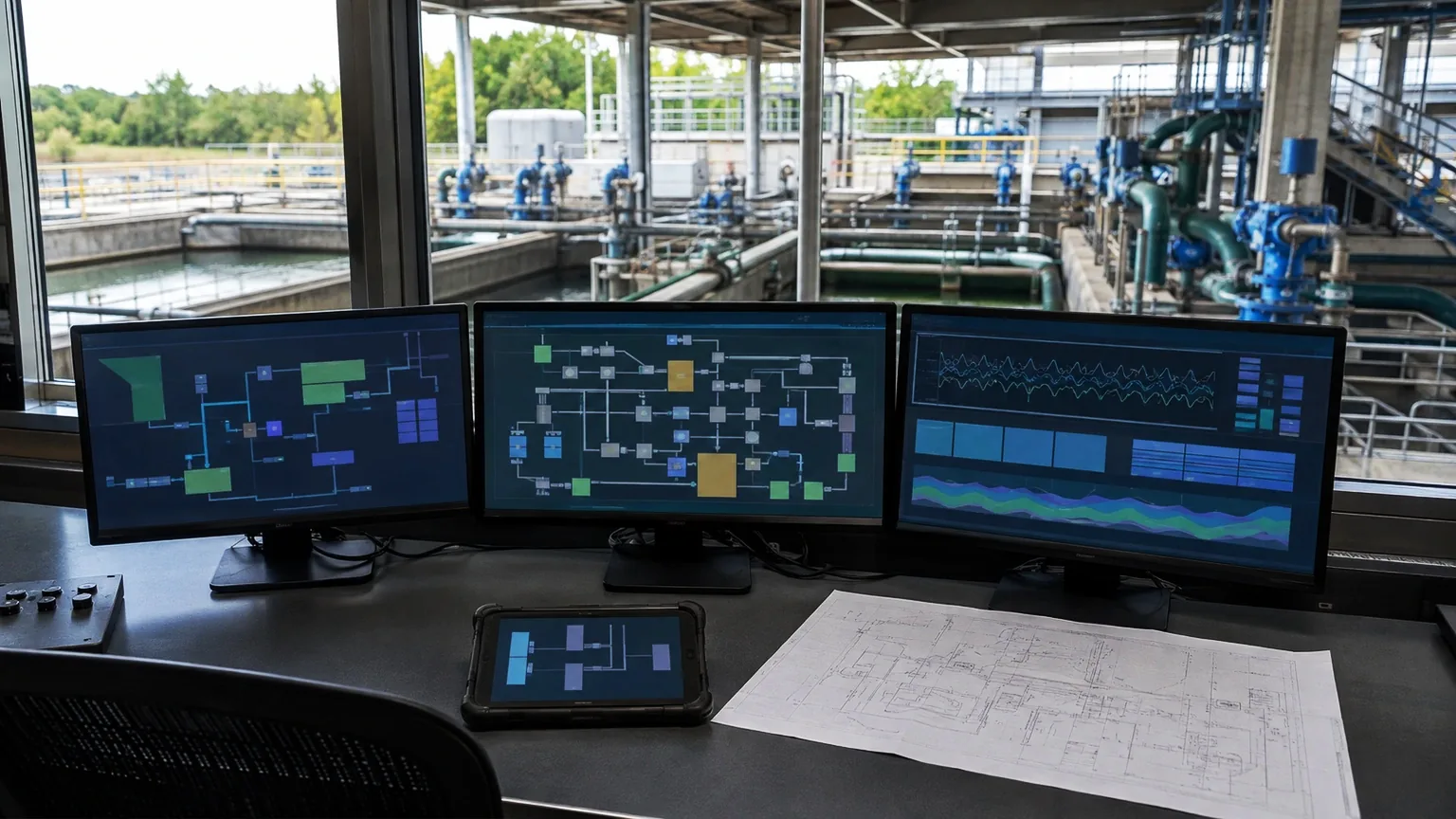
EQUA AIMMS reads work orders from a CMMS or EAM, alarms and tag histories from SCADA historians, asset and network data from GIS, purchase order and budget status from the ERP, and manuals and correspondence from document systems. It writes back only where a customer configures and validates it: work order notes, draft requisitions, filed documents. It never writes to a PLC, DCS or SCADA system. Each system of record stays authoritative.
Key takeaways
- Read-only governs the write, not the conclusion. AIMMS connects to SCADA event sources, historians and IoT sensors, detects anomalies and deviations, can raise the fault itself and alert the responsible people, and still issues no setpoint, restart, interlock or actuator command at any permission level.
- The work order stays in the work management system. Its number, status, labour and cost postings and closure belong there, and AIMMS writes back only the coordination detail a utility has asked it to write.
- The GIS is the asset register at most water utilities. It holds pipe material, install year, diameter, pressure zone and the valves that isolate a section, which is why AIMMS reads it and does not write to it by default.
- The ERP creates the purchase order. Where configured, AIMMS may prepare a draft requisition with the account coding, vendor and supporting quotes attached; the order itself is raised in the ERP under the utility’s own approval workflow.
- Detection is not a condition monitoring programme. Vibration analysis, infrared thermography, oil and wear debris analysis and motor current signature analysis, run against ISO 17359, are a separate discipline with their own instrumentation and specialists.
- “Integration” does at least four different jobs in a sales conversation. Only a connection built against your instance, at your release, with the field mapping validated by your staff, is a fact about your project.
- The operational boundary is architectural rather than configurable. A flag can be set wrongly during implementation or switched on at two in the morning, so ask any vendor to state in the contract that the product has no capability to write to OT systems under any configuration.
The question a utility actually asks is not whether a maintenance system is clever. It is narrower and better: what does this thing read, what does it write, and what breaks if we switch it off.
That question comes from an accurate reading of the situation. A mid-sized water utility already runs a work and asset management system, a historian or a SCADA event log, a geographic information system that is probably the real asset register, a municipal ERP that owns purchase orders, and a document library full of manuals nobody can find quickly. None of that is being replaced. It was paid for, it was configured over years, staff were trained on it, and in several cases it is written into a state reporting obligation.
So this article names things. It sets out the systems EQUA AIMMS is built to work alongside, what is read from each, what is written back and under what conditions, and what stays authoritative when the two disagree. It also sets out what the word “integration” honestly means at pilot stage, which is less than most vendors imply, including us if we are careless.
The three rules that govern all of it
Everything below follows from three commitments. They are worth stating before the lists, because the lists are only interesting if the rules hold.
Operational sources are read-only. AIMMS reads from SCADA event logs, historians and control-system data. It never writes to a PLC, a DCS or a SCADA system. It does not issue a setpoint, a restart, an interlock or an actuator command. There is no permission level, no administrator role and no support ticket that turns this on, because the capability does not exist in the software to be turned on.
Read and write access to business systems exists only where the customer configures and validates it. A work order note, a draft requisition, a document filed to a named library: each of these is a write path, each is scoped by role and permission, each is bounded by spend limits and approval gates the utility defines, and each produces a time-stamped receipt. Which write paths are enabled, and under which approvals, is the utility’s decision rather than ours.
Systems of record stay authoritative. AIMMS is not a CMMS, an EAM or an ERP, and it does not become a second version of the truth. The work order of record stays in the work management system. The asset of record stays wherever your asset register lives, which for most water utilities is the GIS. The financial record stays in the ERP. When AIMMS and a system of record disagree, the system of record is right and AIMMS is wrong, and the job of the integration is to make that disagreement visible quickly rather than to arbitrate it.
The reason for that third rule is not modesty. It is that most maintenance software already records work competently. What it does not do is coordinate the ten or twelve parallel threads that run between an alarm and a verified repair: the evidence gathering, the parts check, the vendor quote, the safety review, the approval that is waiting on somebody who is in a meeting. That coordination is the gap, and closing it does not require becoming the record.
Work and asset management
This is the busiest and most fragmented group, and it has moved a lot in the last five years. Several of the products below are owned by companies that did not own them in 2021, and two are mid-transition to new names right now. That matters practically, because a connector is built against a specific product at a specific release, not against a brand. The two right-hand columns below describe the scope a connector is built to where a customer asks for one. They are not a catalogue of connections already running somewhere, and the section on what integration means at pilot stage sets out how to tell the difference.
| System | Where it stands, September 2026 | What AIMMS reads | What it may write back, only if configured |
|---|---|---|---|
| Trimble Cityworks | GIS-centric work management, widely used in US public works. Trimble has said Unity Maintain will replace Cityworks over the long term, with timelines still undetermined | Work orders, service requests, asset records, inspection history, labour and equipment entries | Work order notes, status updates, attachments |
| IBM Maximo Application Suite | Enterprise EAM, common at larger utilities and authorities | Work orders, job plans, asset hierarchy, PM schedules, inventory balances | Work log entries, planned task detail, attachments |
| Asset Essentials | Formerly Brightly Software, acquired by Siemens in 2022 and sold under the Siemens asset management brand since the 2026 rebrand | Work orders, PM schedules, asset and location records | Work order notes, status updates |
| OpenGov Enterprise Asset Management | The former Cartegraph product, acquired by OpenGov in 2022 | Work orders, asset condition and inspection records, task history | Work notes, completion detail |
| CentralSquare Asset Management powered by Lucity | GIS-centric local government EAM, acquired by CentralSquare in 2019 | Work orders, requests, asset records, cost tracking | Work notes, status updates |
| VUEWorks | GIS-centric enterprise asset management for public agencies. We have not been able to verify its current ownership from a primary source, so we describe the product and not the parent | Work orders, asset and inspection records | Work notes |
| Accela Civic Platform | Permitting, licensing and civic workflow, jointly held by Berkshire Partners and Francisco Partners | Service requests, inspections, permit and compliance records | Record notes, where a workflow allows it |
| Octave Attune EAM | Formerly Infor EAM, acquired by Hexagon in 2021 and renamed HxGN EAM, then carried into Octave Intelligence when that company separated from Hexagon in May 2026 | Work orders, asset hierarchy, materials, PM programmes | Work log entries, attachments |
| SAP Plant Maintenance and S/4HANA Asset Management | The maintenance module inside an SAP landscape | Notifications, orders, functional locations, equipment, materials | Notification long text, order confirmations, where the customer permits it |
| eMaint | CMMS sold by Fluke Reliability | Work orders, assets, PM schedules, parts | Work order notes and status |
| Limble | Mobile-first CMMS, independently operated with institutional investment | Work orders, assets, PM tasks, parts | Work notes, status updates |
| MaintainX | Mobile-first CMMS, acquired by Autodesk in a deal that closed on 3 August 2026 | Work orders, procedures, assets, parts | Work notes, status updates |
| Fiix | CMMS sold by Rockwell Automation | Work orders, assets, PM schedules, parts | Work notes, status updates |
| TMA Systems | Maintenance management with a heavy facilities and education base, backed by Silversmith Capital Partners and acquisitive since 2021 | Work orders, assets, PM schedules | Work notes |
| MicroMain | Long-running CMMS with a facilities and municipal base | Work orders, assets, PM schedules | Work notes |
What stays authoritative here is not ambiguous: the work order. Its number, its status, its labour and cost postings, and its closure belong to the work management system, and any report your board or your state regulator sees should come from there. AIMMS reads that record to understand what is open, and writes back only the coordination detail the utility has asked it to write.
Two practical notes about this group.
First, the product names above are unstable in a way that will affect your procurement paperwork. Cityworks is being succeeded by Trimble Unity Maintain, on a timeline Trimble has not fixed. The EAM that a utility bought as Infor EAM is now sold as Octave Attune EAM, having been HxGN EAM in between. Brightly is now branded under Siemens. If a vendor quotes you a connector by brand name, ask which release.
Second, the depth of the connection varies enormously across this list, and not by how good the product is. It varies by whether the vendor exposes a documented API, whether that API is licensed separately, whether your instance is hosted by the vendor or installed locally, and how much local customisation has accumulated. A twelve-year-old locally installed instance with forty custom fields is a different engineering job from a current cloud tenant, even though both carry the same product name.
Historian and control-system event sources, read-only
This group is where the read-only rule stops being a policy and starts being an architecture.
It is also where a distinction worth making gets made. Read-only governs what AIMMS may WRITE, which is nothing: no setpoint, no restart, no interlock, no actuator command, on any controller, at any permission level. It does not limit what AIMMS may CONCLUDE from what it reads. AIMMS connects to these sources and to IoT sensor feeds directly, watches the tags and events, and detects anomalies and deviations in them. It can raise the fault itself and alert the people who need to know, instead of waiting for an operator to notice a line in an alarm list, and the slower drifts it sees become scheduled work rather than the next incident. Detection is a read. Control is a write. The boundary is on the write.
That is a narrower claim than it may sound, and the narrowness is deliberate. Noticing that a machine has moved away from its own normal behaviour in data a utility is already collecting is not the same as a condition monitoring programme. Vibration analysis, infrared thermography, oil and wear debris analysis and motor current signature analysis, run against the procedure in ISO 17359, are a separate discipline with their own instrumentation and their own specialists. A utility that needs those should buy them as such and hold that vendor to the prediction.
AVEVA PI System. Formerly the OSIsoft PI System; AVEVA completed its acquisition of OSIsoft in March 2021, and AVEVA itself is part of Schneider Electric. PI is among the most widely installed process historians in large water and power operations, and for a maintenance system it is the richest source of what the equipment was actually doing before it failed.
Ignition, from Inductive Automation. Common in municipal water because of its licensing model and its OPC UA connectivity to a wide range of controllers. In many small and mid-sized utilities the Ignition project is both the HMI and the de facto historian.
AVEVA System Platform and InTouch HMI. The former Wonderware line, now sold under the AVEVA name and packaged as AVEVA Operations Control. Very widely installed in water and wastewater plants built or upgraded between roughly 2000 and 2020.
Rockwell FactoryTalk. The historian and event layer alongside Rockwell control hardware, which is one of the most widely installed controller families in US municipal water.
Emerson Ovation. A distributed control system with a long installed base in both power generation and water and wastewater, often at larger treatment plants.
Hach WIMS. Not a control system. It is the water information management platform that holds process and compliance data and produces regulatory reports, and since 2021 the platform has been managed by Aquatic Informatics. It belongs in this group anyway, because the same rule applies for a different reason.
From all of these, AIMMS reads: alarm and event records with their timestamps, tag values and trends around the window of a failure, operator log entries where they are available, and process or compliance values that establish what the plant was doing.
To all of these, AIMMS writes: nothing.
That is the complete answer for the control systems, and it is the complete answer for WIMS too, though the reasoning differs. For a PLC or a DCS, a write path is a physical safety question. For WIMS it is a regulatory integrity question: the compliance record needs exactly one owner, and inserting a maintenance system into the path that produces a discharge monitoring report is a bad idea even when it is technically possible.
What stays authoritative is the control system for what the plant did, the historian for the numbers, and WIMS for what was reported to the regulator.
Geospatial, which for a water utility is not optional
In a factory, the asset register is a list of machines in rooms. In a water utility it is a network: mains, laterals, valves, hydrants, manholes, force mains, lift stations, pressure zones. The assets are linear, they are buried, and they are spread across a service area rather than sitting in a building. That single fact changes what a maintenance system needs to know.
Esri ArcGIS is the standard in practice at most US water utilities, and the ArcGIS Utility Network is the data model that carries connectivity and topology rather than just geometry. This is not a nice-to-have integration for a water utility. It is often the only place that knows the pipe material, the install year, the diameter, the pressure zone and, critically, which valves have to be closed to isolate the section a crew is about to work on.
It is also why so many of the work management products above are described as GIS-centric. Cityworks, Lucity, the former Cartegraph product and VUEWorks all sit on top of an Esri geodatabase by design. If your GIS is the asset register in practice, then a maintenance system that cannot read it is guessing about the asset.
AIMMS reads feature classes and asset attributes, network topology and traces, and service area or zone boundaries. It does not write to the GIS by default. Where a utility wants an inspection observation or a photograph associated with a feature, that write path is configured, scoped to specific layers and fields, and validated with the GIS administrator before it is enabled, because an uncontrolled write to a geodatabase is one of the faster ways to damage an asset register.
The GIS stays authoritative for the asset.
Finance and procurement
This is where a repair usually stops moving, and it is also where the integration story is least glamorous.
Tyler Technologies Enterprise ERP, which nearly everyone still calls Munis, is one of the most widely used financial systems of record in US local government. Oracle and SAP appear at larger utilities and at authorities that share a system with a parent city or county.
AIMMS reads requisition and purchase order status, budget and account codes, vendor master records, and contract and pricing terms where they are available. Where a customer configures it, AIMMS may prepare a draft requisition with the correct account coding, the correct vendor and the supporting quotes attached. It does not create the purchase order. The purchase order is created in the ERP, under the utility’s own approval workflow, by the person whose signature authority covers it. The receipt AIMMS produces records who approved what and when, and it is a record of the approval, not a substitute for it.
Supplier and distributor quoting deserves an honest paragraph, because it is the part most often oversold. A meaningful share of water utility procurement still runs on email, PDF quotes, and a phone call to a regional distributor branch. Some suppliers have portals. Fewer have APIs that a third party may use. AIMMS handles this the way the work is actually done: it assembles the request with the correct part numbers and specifications, tracks which suppliers were asked and when, chases the ones that have not replied, normalises the quotes that come back so they can be compared on price, lead time and terms, and routes the comparison into the approval the utility has defined. That is genuinely useful and it is not an API integration. Any vendor telling you they have a live connection into your distributor’s pricing should be asked which distributor, at which customer, and since when.
The ERP stays authoritative for money.
Documents and communication
Microsoft 365, Outlook and SharePoint are the default at most utilities; Google Workspace appears at a meaningful minority. This is where the O&M manual lives, and the drawing, and the SOP, and the three-year-old email thread with the pump vendor that contains the answer.
AIMMS reads document libraries and named folders, retrieving the correct manual revision, the relevant drawing and the standard operating procedure attached to the task. Where configured, it reads vendor correspondence threads for a specific job so the quote history is in one place rather than in four inboxes. Where configured, it drafts correspondence and files completed records back into a named library.
Two constraints are worth stating. Access is scoped to specified sites, libraries or shared mailboxes, not to a tenant. And retention stays where it is: if your document library is governed by a records retention schedule, that schedule keeps governing, and AIMMS does not become a shadow archive with a different deletion policy.
What “integration” honestly means at pilot stage
The word does at least four different jobs in vendor conversations, and they are worth separating, because only one of them belongs on your project plan.
- We are in the same ecosystem. Our product also runs on Esri, or we are listed as a partner. This tells you something about direction and nothing about effort.
- We can read an export. A scheduled CSV or a database view. This works, it is often the right way to start, and it is not what most people picture when they hear “integration”.
- We have connected to this product before, at another customer. Real experience, real reduction in risk, and still not a guarantee, because their release, hosting model, custom fields and permission model are not yours.
- We have connected to this product at your site, against your instance, and validated the field mapping with your staff. This is the only one that is a fact about your project.
Connector work is scoped and validated per customer. Anyone who tells you otherwise is describing a version of your utility that does not exist. The variables that decide the effort are boring and predictable: which release you are on, whether the instance is vendor-hosted or installed locally, whether the API is included in your licence or sold separately, how many custom fields have accumulated, who holds the administrative credentials, and whether there is a test instance to work against. A pilot plan that does not name those variables is not a plan.
No vendor should claim a turnkey connection to a system it has not connected to at that customer. That applies to us. If we have not connected to your specific instance, the accurate statement says so, names where that product has been connected before if it has been, and gives the expected duration of the work, with the field mapping validated by your staff before anything is enabled.
The pattern worth following is unglamorous. Start read-only in every direction, including the business systems. Prove the coordination is useful when AIMMS can see everything and change nothing. Then enable exactly one write path, usually a work order note, watch it for a few weeks, and add the next one. A pilot that begins with six write paths enabled is measuring integration risk, not maintenance outcomes.
Why the operational boundary is architectural rather than configurable
Utilities are right to press hard on this, and the reason is recent.
On 30 July 2026 the FBI and the Environmental Protection Agency issued a joint public service announcement, alert I-073026-PSA. Since 27 July 2026, water and wastewater utilities in at least seven states had reported incidents. The targeted devices were internet-exposed Rockwell Automation and Allen-Bradley PLCs, specifically the MicroLogix 1100 and 1400 series. The actors changed IP addresses and set passwords. Utilities lost view of their equipment and in some cases lost control of it, and reported operational effects included loss of pressure and flooding. The advisory also observed that similarities in network arrangements provided by third parties may let an attacker repeat a success across multiple utilities that share the same build.
Read that last point again, because it is the one that bears on vendor selection. The shared exposure was not a flaw in any single utility’s judgement. The advisory puts the shared-build risk as a possibility rather than a confirmed cause, and the possibility is enough: where several utilities buy a similar arrangement from similar suppliers, one success can be repeated across all of them. Adding another supplier with a path toward the control network is exactly the kind of decision that produces that pattern.
So a superintendent who asks whether a new maintenance system can touch a PLC is not being obstructive. They are asking the question the July advisory should have made routine.
The answer has to be structural, and here is why the distinction matters. A configuration flag can be set wrongly during implementation. It can be inherited from a template. It can be turned on by an administrator under pressure at two in the morning, for a good reason, permanently. A capability that exists is a capability that will eventually be exercised. The commitment worth making, and the one worth demanding from any vendor, is that the write path does not exist in the software at all.
That is a claim you can test. Ask the vendor to state in the contract that the product has no capability to write to OT systems under any configuration. Ask what protocols the software implements and in which direction. Ask whether the connection is outbound-only from the operational side, and through what. A vendor whose answer is a screenshot of an unticked checkbox has answered a different question than the one you asked.
What to ask any vendor claiming an integration
This list is not written to flatter us. Use it on us.
- Name the exact product and release you have connected to, and describe the customer. Not the brand. The release, the hosting model, and whether that customer was a utility of comparable size.
- Is the connection to a documented API, to the database directly, or to a file export? Each fails differently. Direct database reads break on upgrades. Exports go stale silently.
- Who pays for the API licence, and is it in the price you have quoted me? More than one of the systems above charges separately for integration access.
- When the source system is upgraded, who fixes the connector, on what timeline, and at whose cost? Get this in the contract, not the proposal. Several of the products named in this article are mid-rename or mid-platform-transition.
- Show me field by field what is written back, and who approves each write. If the answer is a category rather than a field list, the work has not been scoped.
- What happens when the connection is down? Does work stop, does it queue and reconcile, or do the two systems quietly diverge until someone notices in a month?
- When the two records disagree, which one wins, and how do I find out that they disagreed? A reconciliation report you can read is worth more than a promise that it will not happen.
- Does the product write to any OT system, ever, under any configuration? Then ask for it in writing, with the protocols named.
- If I terminate, what do I keep, in what format, and how long does the export take? Ask whether the repair history and the receipts come out in a form your next system can read.
- Who at your company has done this specific integration, and may I speak to that customer? The absence of a reference is itself an answer.
A utility that asks these ten questions of every vendor on its shortlist will get shorter, more useful proposals, and will find out early which claims were about a product and which were about a plan.
Where to go next
- The Fault-to-Fix Execution Gap sets out the coordination work that runs between an alarm and a verified repair, which is the gap the connections in this article exist to close.
- AI CMMS vs EAM vs APM vs Predictive Maintenance separates the four software categories a utility is usually comparing at once, and says which one owns which record.
- Cityworks vs Maximo vs Cartegraph for Water Utilities compares what the leading work management products actually do once the alarm has been raised and the work order exists.
Sources
- Federal Bureau of Investigation and Environmental Protection Agency, Public Service Announcement I-073026-PSA, “Malicious Cyber Actors Targeting Water and Wastewater Sector Internet-Facing Programmable Logic Controllers, Causing Operational Disruptions”, 30 July 2026.
- Cybersecurity and Infrastructure Security Agency, “CISA Urges Water and Wastewater Systems Sector to Protect OT Against Activity Targeting PLCs”, 30 July 2026.
- Trimble, “What happened to Cityworks? Transition to Trimble Unity Maintain”, accessed September 2026.
- Siemens, “Brightly Software is now Siemens Asset Management Software”, 2026.
- OpenGov, “OpenGov Continues Expansion with Acquisition of Operations and Asset Management Leader Cartegraph”, July 2022.
- CentralSquare Technologies, “CentralSquare Acquires Lucity”, January 2019.
- Accela, “Accela Advances Momentum with New Strategic Investment from Francisco Partners”, September 2023.
- Hexagon, “Hexagon completes the acquisition of Infor’s EAM business”, October 2021.
- Hexagon, “Hexagon proposes distribution and listing of Octave Intelligence plc and provides update on planned spin-off”, 2026.
- Autodesk, “Welcoming MaintainX to Autodesk: The next chapter in connected operations”, 3 August 2026.
- AVEVA, “AVEVA and the PI System together: seven things to expect”, accessed September 2026.
- Schneider Electric, AVEVA PI System product range, accessed September 2026.
- AVEVA, “Wonderware Solutions Are Now AVEVA Solutions”, accessed September 2026.
- Emerson, Ovation Distributed Control System, accessed September 2026.
- Aquatic Informatics, Hach WIMS Water Information Management Solution Platform, accessed September 2026.
- Esri, Understanding the ArcGIS Utility Network: A Guide for Water Utilities, accessed September 2026.
- Tyler Technologies, Enterprise ERP, accessed September 2026.
- Fluke, eMaint CMMS, accessed September 2026.
- Fiix by Rockwell Automation, Fiix CMMS, accessed September 2026.
- Silversmith Capital Partners, “TMA Systems Raises $68 Million Growth Investment Led By Silversmith Capital Partners”, October 2021.
- Aquatic Informatics, “Hach and Aquatic Informatics Partnership”, accessed September 2026.
- Inductive Automation, Ignition SCADA platform, accessed September 2026.